Professional Furnace Repair Insights: Why Your Furnace May Be Working Harder Than Your Edmonton Home Needs
Edmonton winter seasons have the capability to reveal furnace inefficiencies that may remain under in milder weather. A room starts feeling colder than the rest of the house. The furnace seems to be running longer. Then the utility bill arrives and makes you wonder what changed. None of this necessarily means the furnace is about to fail. Sometimes the bigger concern is quieter: the system is working, but something about the way it works is costing you.
1. When the Furnace Cannot “Breathe,” Everything Else Feels It
When your furnace is under restrictive air flow, it can still function, but it takes more effort. Which means more fuel consumption. You may notice weak airflow, uneven rooms or a blower that sounds like it is working unusually hard. A loaded filter, restricted return-air path or blocked register can make it harder for the blower to move air around the house.
Take a closer look if you are seeing things like:
- Noticeably weak airflow from several registers
- Bedrooms that stay colder than the main living areas
- A blower that sounds louder than usual
- Filters becoming dirty unusually quickly.
Changing a filter is routine homeowner maintenance. Persistent airflow problems are different. Such challenges require a 24/7 Furnace Repair Edmonton professional who can measure what is happening, for precise diagnostics and repairs, rather than simply increasing the furnace’s workload or just cranking up the fan speed which can strain the motor.
2. The Furnace Can Make Good Heat and Still Lose the Battle
Your furnace can produce heat efficiently and still fail to deliver that heat effectively. That means producing heat efficiently does not guarantee that all of it reaches the rooms where you want it.
Ductwork is the bridge, a physical pathway that carries hot and cold air. That makes it a critical suspect for heat drops between production and release. Poorly sealed connections can allow conditioned air to escape. The result can be a floor that feels comfortable, while one bedroom or another part of the house never quite catches up.
A proper assessment may consider:
- Accessible duct connections
- Insulation around exposed ductwork
- Return-air performance
- Supply-air distribution
- Temperature differences between rooms.
And this is where professional judgment saves money. If the real problem is distribution, replacing the furnace with a larger one may simply give you a bigger machine trying to overcome the same weakness.
3. A Furnace Does Not Have to Stop Working Before Something Is Wrong
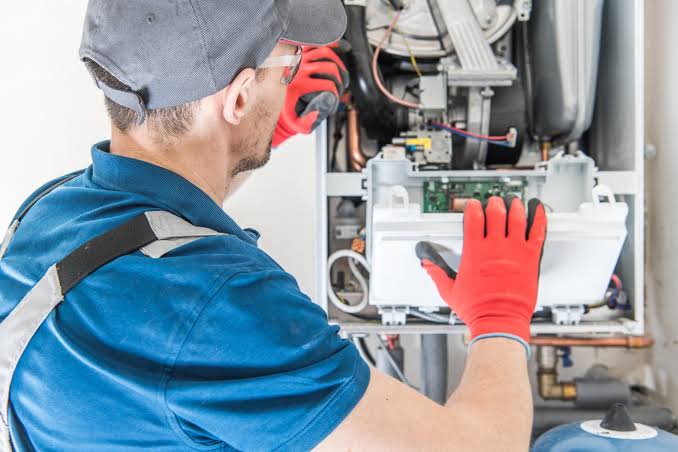
This is probably the most easily missed part. A furnace can continue producing heat while combustion performance is deteriorating. Burner contamination, gas-pressure issues, venting problems or condensate trouble can all affect how the appliance operates.
These are not “let’s see what happens” situations. Gas-fired equipment needs proper testing.
A qualified technician can assess things such as:
- Gas pressure
- Combustion performance
- Carbon-monoxide conditions
- Venting
- Heat-exchanger condition.
That is considerably more useful than looking through the cabinet and saying, “The flame looks fine.” Professional service asks a better question: Is the furnace burning fuel, transferring heat and exhausting combustion products the way it was designed to?
4. Real Efficiency Is About the Entire Installation
The best furnace efficiency check looks at the whole system. Imagine paying for a premium furnace and then judging its performance solely by the efficiency number printed on its label. That tells you what the equipment was designed to achieve under standardized conditions—not necessarily how the complete installation is performing today.
A stronger assessment connects the pieces.
A technician may investigate:
- Temperature rise
- External static pressure
- Blower performance
- Filter resistance
- Combustion readings;
- Operating and diagnostic history.
That information can reveal why a furnace is running longer than expected or why energy consumption has increased without an obvious breakdown.
For an Edmonton homeowner, this is where skilled service becomes valuable. You are not simply looking for someone to “tune the furnace.” You want someone capable of distinguishing an equipment problem from an airflow, installation or operating-condition problem—and then recommending the least disruptive solution that actually addresses it.In essence, furnace efficiency is not a number you buy once and forget. It is the result of how equipment, installation, maintenance and the home continue to work together. If your furnace seems increasingly expensive or strained, treat that change as useful information. A thoughtful assessment now can reveal opportunities to improve comfort and protect the system before winter turns a small weakness into a costly problem. Pay attention to those changes. They are useful clues—and with the right professional assessment, they can lead to a solution before winter turns a quiet inefficiency into an
Related Posts